

Goal of this session
Select one opportunity for AI, explore the current process or task, decide which part could be supported by a GPT, and prepare a short pitch.
Water Europe context
Water Europe works as a European association and ecosystem organisation. The work connects members, projects, advocacy, collaboration, communication and EU-level developments.
Recurring communication with a diverse member base: corporates, SMEs, public bodies, universities, NGOs and civil society.
Understanding tender documents, supporting proposals, planning deliverables and preparing reporting or communication input.
Following European developments and turning input from members, expert groups and project results into usable policy or stakeholder material.
Promising starting points
Good Water Europe use cases
- Summarising complex tender documents or project input.
- Turning technical input into clear member or stakeholder communication.
- Creating communication and content plans based on project deliverables.
- Preparing first drafts of proposal sections.
- Answering recurring member questions in a consistent way.
- Monitoring EU policy developments and preparing short briefings.
Common challenges to consider
- AI output can be inaccurate and needs review.
- Prompting is often ad hoc, so results vary.
- Documents are not always structured for easy AI use.
- There is no shared AI workflow or quality check yet.
- Not everyone has the same AI experience or technical background.
- Trust, privacy and human responsibility need to be explicit.
90-minute working rhythm
| Time | Activity | Output |
|---|---|---|
| 10 min | Choose and frame one opportunity | One clear opportunity statement |
| 35 min | Map the current process and identify friction | Process steps, pain points and possible GPT support |
| 15 min | Define the GPT focus | Which process step(s) the GPT will support and what value it creates |
| 10 min | Run an AI Fit Check | Feasibility, clarity and risk view |
| 20 min | Prepare the pitch | 2-minute GPT concept pitch |
Choose and frame the opportunity
Choose one opportunity from the brainstorm. Make it specific, recognisable and practical for Water Europe.
We want to explore how a GPT could help colleagues answer recurring member questions and prepare onboarding follow-up emails in a consistent Water Europe style.
We want to explore how a GPT could help project teams turn deliverables and technical input into a content and communication planning.
We want to explore how a GPT could help colleagues interpret tender documents and prepare first drafts of recurring proposal sections.
We want to explore how a GPT could help monitor EU policy developments and turn relevant signals into short internal briefings.
Map the process and find the friction
Describe how the task or process works today. For each step, identify the pain point and whether a GPT could help.
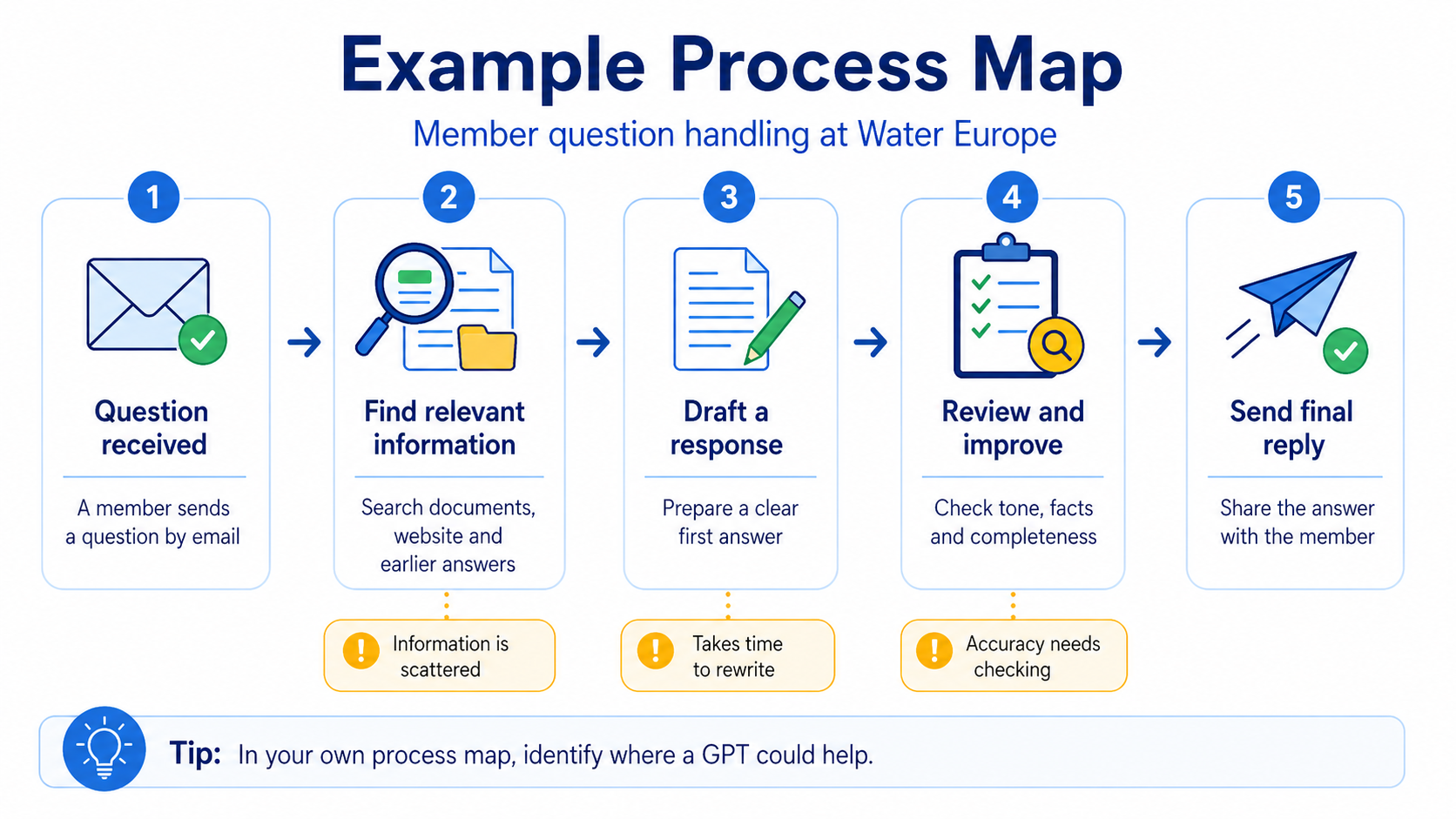
Question comes in → find the right information → draft answer → check details → send response → store/update knowledge.
Tender arrives → read requirements → interpret key points → collect input → draft sections → review and adapt.
Project deliverables → identify messages → define audiences → plan channels → draft content → review and publish.
| Step | What happens? | Who is involved? | Input | Output | Pain or friction | Could a GPT help? |
|---|---|---|---|---|---|---|
| 1 | ||||||
| 2 | ||||||
| 3 | ||||||
| 4 | ||||||
| 5 | ||||||
| 6 |
Look for friction such as
- Repeated uploading and re-uploading of documents.
- Checking AI output for accuracy takes too long.
- Similar projects require slightly different wording.
- Technical input needs to become accessible communication.
- EU developments are difficult to monitor consistently.
- Information is scattered across documents, websites and people.
Expected value could be
- Faster understanding of complex input.
- More consistent member communication.
- Better reuse of existing content and formats.
- Clearer first drafts for review.
- More structured quality control.
- Less dependency on one expert or one tool.
Define the GPT focus
Look back at your process map. Decide which step or steps are most suitable for GPT support. Be clear about the value and what remains human work.
Support the step where technical project input is turned into clear communication messages for members.
Less time spent rewriting and more consistent tone across projects.
A colleague checks facts, confidentiality and political sensitivity before external use.
How might we help [user] use a GPT to support [selected process step/task], so that [value], while [human responsibility/safeguard] remains in place?
Run an AI Fit Check
Score your idea quickly. If it scores low, make the use case smaller, safer or more specific.
| Criterion | Score 1-5 | Notes |
|---|---|---|
| Clear user | ||
| Clear input | ||
| Clear output | ||
| Text-heavy or knowledge-heavy task | ||
| Repeated often enough | ||
| Safe with human review | ||
| Clear source strategy |
Prepare your pitch
Prepare a 2-minute pitch. Keep it sharp and practical.
| Pitch element | Your notes |
|---|---|
| We analysed the process of... | |
| The main friction point is... | |
| We selected process step(s)... | |
| Our GPT will help by... | |
| The expected value is... | |
| The GPT will use these sources or inputs... | |
| The main boundary or risk is... |
Before you finish
Useful ChatGPT prompts
Use these prompts to speed up your analysis. Replace the text between brackets with your own information.
Prompt 1: Map the process and friction
# Task
We are analysing a possible GPT use case for Water Europe.

## Opportunity
[Describe the opportunity]

## Water Europe context
[Member communication / EU projects / proposal preparation / advocacy and policy / communication planning / other]

## Instructions
Help us map the current process in 5 to 6 steps.

For each step, identify:
- What happens
- Who is involved
- What input is needed
- What output is created
- What pain or friction exists
- Whether a GPT could help

Pay attention to:
- Factual accuracy
- Confidentiality
- Human review
- Source quality
- Repeated work

## Output format
Return the result as a markdown table with these columns:

| Step | What happens? | Who is involved? | Input | Output | Pain or friction | Could a GPT help? |
|---|---|---|---|---|---|---|

Ask short clarification questions first if needed.
Prompt 2: Choose the best GPT focus
# Task
Help us choose the best GPT focus based on our process map.

## Process map
[Paste the process map here]

## Instructions
Compare the possible GPT support options based on:

- Expected value for Water Europe
- Feasibility in a first prototype
- Clarity of input and output
- Risk of inaccurate output
- Confidentiality
- Need for human review
- Whether the task is repeated often enough

## Output format
Return your answer in markdown using this structure:

### Recommended GPT focus
[Describe the best process step or task for GPT support]

### Why this is the best focus
- [Reason 1]
- [Reason 2]
- [Reason 3]

### Comparison table

| Option | Value | Feasibility | Risk | Human review needed | Score |
|---|---|---|---|---|---|

### How to make the use case smaller or safer
- [Suggestion 1]
- [Suggestion 2]
Prompt 3: Create a design question
# Task
Help us formulate a strong design question for our GPT idea.

## Context
We are designing a custom GPT for Water Europe.

## GPT idea
[Describe the GPT idea]

## Design question structure
Use this structure:

> How might we help [user] use a GPT to support [selected process step/task], so that [value], while [human responsibility/safeguard] remains in place?

## Instructions
Create 5 versions.

The design questions should be:
- Specific
- Practical
- Suitable for a custom GPT
- Relevant to the Water Europe context
- Clear about human responsibility or review

## Output format
Return the result in markdown:

### Version 1
...

### Version 2
...

### Recommended version
[Choose the strongest version and briefly explain why]
Prompt 4: Check whether this is a good GPT use case
# Task
Evaluate whether this idea is suitable for a custom GPT.

## GPT idea
[Describe idea]

## Evaluation criteria
Score each criterion from 1 to 5:

- Clear user
- Clear input
- Clear output
- Text-heavy or knowledge-heavy task
- Repeated often enough
- Safe to support with AI
- Human review possible
- Clear source strategy
- Confidentiality risk

## Output format
Return the result as a markdown table:

| Criterion | Score 1-5 | Reason | How to improve |
|---|---:|---|---|

Then add:

### Overall assessment
[Is this a strong GPT use case? Why?]

### Make it smaller, sharper or safer
- [Suggestion 1]
- [Suggestion 2]
- [Suggestion 3]
Prompt 5: Prepare the pitch
# Task
Help us prepare a 2-minute pitch for our GPT idea.

## Input
Use the information below:

- Process analysed: [describe process]
- Main friction point: [describe friction]
- Selected process step(s): [describe steps]
- GPT support: [describe what the GPT will do]
- Expected value: [describe value]
- Sources or inputs: [describe sources or inputs]
- Main boundary or risk: [describe boundary or risk]

## Pitch structure
Use this structure:

1. We analysed the process of...
2. The main friction point is...
3. We selected process step(s)...
4. Our GPT will help by...
5. The expected value is...
6. The GPT will use these sources or inputs...
7. The main boundary or risk is...

## Output format
Return the pitch in markdown:

### 2-minute pitch
[Write the pitch]

### One-sentence summary
[Write one strong sentence that captures the idea]

Keep it clear, practical and convincing for a group of Water Europe colleagues.